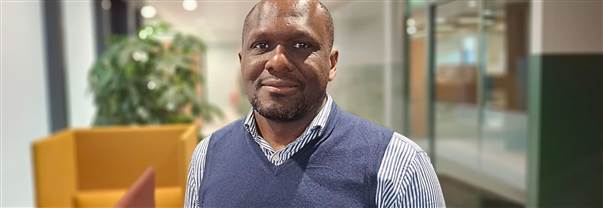
Olaf, data-powered
A passionate mathematician, Olaf puts his talent to work toward a clear objective: preserving resources
Meet Olaf
Disciplines: Chemistry, Wastewater Treatment, Environmental Science
Mission: Optimising wastewater treatment processes, monitoring water quality and protecting natural ecosystems through sustainable water management.

Certain tasks at a wastewater treatment plant may seem unremarkable: analysing a sample, checking the pH level, calibrating an instrument or recording a measurement in a logbook, for example. For Hari Om Tiwari, however, every one of these tasks counts. “Small actions carried out consistently bring about major positive changes,” he explains. This conviction informs his daily work as a laboratory chemist at SUEZ, where he plays a vital role in protecting water resources, reducing pollution, and promoting public health.
Hari Om Tiwari, originally from Uttar Pradesh, built a solid scientific foundation from a very early age. After studying chemistry and zoology, he went on to complete a Master’s degree in environmental science at Dr Ram Manohar Lohia University in Ayodhya, in the north of the country. From an early age, he developed an interest in natural systems, water pollution, and the practical solutions that science can offer to environmental challenges.
“I realised that science isn’t just about theory; it can also help solve real-world problems and improve society,”
he explains. It was this practical approach that led him towards wastewater treatment, a field in which scientific analysis has a direct, day-to-day environmental impact.
Small actions, when carried out consistently, can bring about big, positive changes.Hary Om
Before joining SUEZ, Hari Om gained over ten years of solid experience monitoring industrial and urban waste treatment plants. He initially worked for an industrial group on effluent treatment projects, before working as a laboratory chemist on wastewater treatment plant construction projects. These roles enabled him to develop his skills in water analysis, performance monitoring, environmental compliance, and operational management.
For the past three years, he has worked at SUEZ as a laboratory chemist at the Bharwara wastewater treatment plant in Lucknow, northern India. It is one of the largest wastewater treatment plants in the country, operated by the Group. Every day, he ensures that the millions of litres of treated wastewater, over 300 million litres a day, meet environmental standards.
In his line of work, precision is not just a detail; it is essential for making the right operational decisions. Hari Om is responsible for maintaining laboratory records and ensuring the reliability of results, as well as for instrument calibration and document control. This data enables operators and engineers to adjust the plant’s operations in real time.
“Reliable laboratory results are essential for maintaining operational efficiency and environmental compliance,” he emphasises. The clear objective behind this rigour is to prevent inadequately treated water from being discharged into the environment.
Through his analyses, Hari Om helps the operations teams optimise treatment processes to sustainably manage water for several million people and protect watercourses, notably the River Gomti.
One of Hari Om's most vivid memories illustrates the crucial role played by the laboratory. During a routine check, he detected an abnormal variation in several parameters and noticed that the quality of the treated water had begun to fluctuate. He immediately alerted the operations teams. Together, they identified a sudden increase in the influent load and adjusted the aeration, paying closer attention to sludge recirculation. The process stabilised.
For Hari Om, this episode demonstrates that wastewater treatment relies on collective effort. “Although laboratory monitoring plays an important role, the success of operations depends on the combined efforts of operators, engineers, maintenance staff and laboratory personnel.”
Hari Om is motivated day in, day out by the knowledge that he is making a direct contribution to protecting the environment and public health. “Proper wastewater treatment helps to reduce pollution and protect natural water resources,”
he explains. His work, which is often carried out behind the scenes, helps to keep rivers and natural environments safe. He is particularly proud to have contributed to the operational stability of the Bharwara plant, even in challenging conditions.
For Hari Om, the future of wastewater treatment and processing will be characterised by automation, online sensors, real-time monitoring, artificial intelligence, the reuse of treated water, and the recovery of resources. Treatment facilities will no longer merely be tools for pollution control; they will also become platforms for producing recycled water and energy and recovering nutrients from sludge.
He advises young people wishing to pursue a career in environmental science to build a solid foundation in chemistry, biology, mathematics and environmental science, while also seeking out practical experience in the field. “You must remain curious, keep learning, and approach this profession with a sense of responsibility and a passion for protecting the environment,”
he says. In a world facing resource scarcity, water pollution and climate change, Hari Om Tiwari embodies a patient and practical approach to applied science. It is a hands-on approach, based on precise measurements, cooperation and commitment. It is a science that transforms the attention paid to a water sample into tangible environmental protection every day.
.jpg?h=208&w=603&v=1&d=20260703T125410Z&format=jpg&crop=0&hash=34B879C77FC5D04FA4E1021B836EB7CE "MIN_2000x1125px (1)")
For Min, research is not abstract. It is fuelled by her personal history, her sensitivity to nature, and her strong conviction that understanding pollution is crucial to preserving water, the environment, and public health.

As a specialist in health risk assessment at CIRSEE, SUEZ’s international research centre, Jérôme has a job that few people would guess
As Head of Oceanography at SUEZ, Marc uses numerical modelling to predict ocean movements and reduce the environmental impact on marine ecosystems.