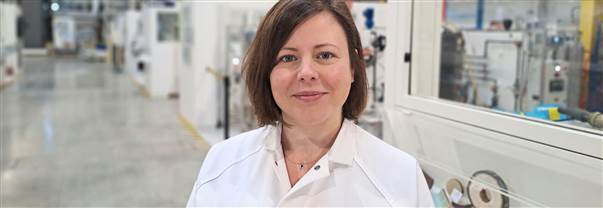
Deep within sewer networks or at the heart of waste treatment plants, Julie is pushing science forward with machines unlike any others. Robots capable of operating in hazardous environments to inspect, collect data, or carry out demanding and repetitive tasks. For this robotics expert, every project begins with the same question: what is its real purpose, and who will it truly serve?
Julie did not grow up surrounded by robots. “I discovered them later, through my studies,” she explains. But science captivated her from an early age. As a child, she already dreamed… of inventing new fruits and vegetables. “There was already that spirit of invention, even if I didn’t yet know what it really involved!” In middle and high school, physics and mathematics naturally stood out. “I liked their logic.” After a scientific baccalaureate and preparatory classes, Julie joined a general engineering school in Toulouse, where the practical applications of theory were mainly drawn from the aeronautics field. The real turning point came in Canada.
Robotics must serve to enhance the safety of our operatorsJulie
Montreal : the robotics turning point
In her final year, Julie went to study in Montreal. There, she chose her courses and discovered robotics. “It was an instant match.” She became passionate about this multidisciplinary, hands-on, fast-evolving field. She then secured an internship working on assistive technology for people with severe disabilities: a robotic arm mounted on a wheelchair to give patients greater autonomy. “Robotics became a direct service to people. It gave real meaning to my work.”
From research to industrial impact
Julie continued with a PhD, then flew to Japan to apply her research in collaborative robotics, control systems, and intent detection on one of the first advanced humanoid robots. She then spent fifteen years at the CEA (French Alternative Energies and Atomic Energy Commission), within the technological research division. There, she worked at the intersection of robotics, industry, and human needs. “I saw a huge variety of factories, professions, and environments.” From clean rooms to station rooftops, from nuclear to aerospace, she supported industrial players in adapting cutting-edge technologies. A highly formative experience, but one that gradually sparked a new aspiration. “At some point, I felt the need to fully commit to a single company, and especially to a field aligned with today’s societal challenges, such as the environmental transition.”
Joining SUEZ to unlock the full potential of robotics
Three years ago, Julie chose to join SUEZ. It was an obvious decision. “I didn’t want to do robotics just to produce more and more. I wanted it to serve environmental and societal challenges.” When she arrived, robotics already existed—particularly in sewer networks and waste sorting centers—but its potential was immense. Her mission within LyRE, one of the Group’s research and innovation centers: to structure, develop, and expand the use of robotics across all SUEZ activities.
Among the projects she initiates and leads, the robotic dog immediately draws attention: a quadruped capable of exploring wastewater networks, enabling access to environments that are inaccessible to humans and replacing human intervention in hazardous settings. “Robotics must first and foremost serve to strengthen the safety of our operators—for example, in networks where gases such as hydrogen sulfide may be present.” The robot, meanwhile, can autonomously navigate tunnels, overcome obstacles, operate in water, and collect the data needed for asset management. “The quadruped format proved ideal for its agility and ability to adapt to the highly variable environment of sewer networks.” A project fully aligned with two key priorities of the Group: Health & Safety and operational performance.
Towards automated and robotized WEEE dismantling chains
Another strategic focus: the dismantling of waste electrical and electronic equipment (WEEE), the fastest-growing waste stream worldwide. “We simply do not have the capacity today to process these volumes.” These waste items are both hazardous (batteries, capacitors, fluids) and rich in critical materials. The challenge: to automate and robotize certain key steps to improve operator safety and the competitiveness of the sector. “The idea is to create a true dismantling methodology: knowing when and how to carefully disassemble for reuse, and when to recycle more quickly. To do this, we need to build real dismantling lines, just like assembly lines in the automotive industry.”
Tomorrow, we'll wonder how we ever did without it
Leading a small team of four, Julie works closely with operators. “They hold the key. A robot developed without them is useless.” On-site testing, continuous dialogue, adjustments: robotics is co-developed. “I’ve even seen an operator postpone their vacation to attend test sessions! It shows their commitment—and their expectations.”
For Julie, robotics is not meant to replace people, but to remove them from the most dangerous situations. Certain highly exposed or physically demanding tasks will gradually evolve, transforming professions so deeply that “tomorrow, we’ll wonder how we ever did without it.”
Her most forward-looking vision? Designing a robot capable of navigating extremely confined spaces such as drinking water pipelines. A major technological challenge that could be addressed through soft robotics, an emerging field. Inspired by living organisms, this approach relies on flexible, deformable materials capable of adapting to complex shapes—bending, contracting—where rigid robots reach their limits. “Everything still has to be invented,” Julie acknowledges. “But if we manage to operate directly inside networks, the environmental and economic impact will be considerable: fewer construction works, less water loss, and fewer disruptions.” An ambitious and forward-thinking vision, combining scientific innovation with ecological transition.
Finally, when discussing science fiction scenarios and rebellious robots, Julie brings the conversation back to reality. For her, robotics remains a tool fully controlled by humans. The real danger lies in human error or malicious intent. “Robots neither have nor develop consciousness. Even if the technology could move very fast, we choose to take the necessary time: to guarantee safety, reliability, and full control over their actions.” A clear and deliberate vision: ethical robotics, designed not as an end in itself, but as a tool serving humanity.

.png?h=345&w=613&v=1&d=20260605T133336Z&format=png&crop=1&hash=9D154C3F99DAB297364548BC2235A86B)