
Our presence in Uzbekistan

With a presence since 2018 in Uzbekistan, we are the trusted partner for circular solutions in water and waste treatment.

As a global leader in the water and waste management sectors, we have been operating for over 160 years all over the world, providing essential services to protect the resource and improve quality of life wherever we operate. With operations in 40 countries and 40,000 employees, we supply innovative and resilient water and waste services solutions to our customers, enabling them  – whether local authorities or industrial groups – to create value over the entire lifecycle of their assets and services, and to drive their ecological transition, together with their end-users. In 2024, we provided 68 million people worldwide with drinking water and 44 million with sanitation services. A total of 8 TWh of energy was generated from waste and wastewater. Our global revenues amounted to 9.2 billion euros.

As a passionate and committed team, we enable our customers to:

Provide access to water and waste services, with resilient and innovative solutions

Create value over the entire lifecycle of their assets and services

Drive the ecological transition, together with their end users

Our news

March 12th, 2025 - SUEZ, strategic partner of the Uzbek authorities, with two new agreements to support the environmental transformation of the country

On the occasion of the official visit of the President of the Republic of Uzbekistan to France, SUEZ announces the signing of two agreements to support the country in meeting its environmental challenges. These new agreements are part of the long-term relationship of trust between SUEZ, a strategic partner in the water sector, and the Uzbek authorities.


Nov. 22nd, 2022 - SUEZ launches its landmark contract in Tashkent and becomes the strategic partner of Uzbek authorities in water

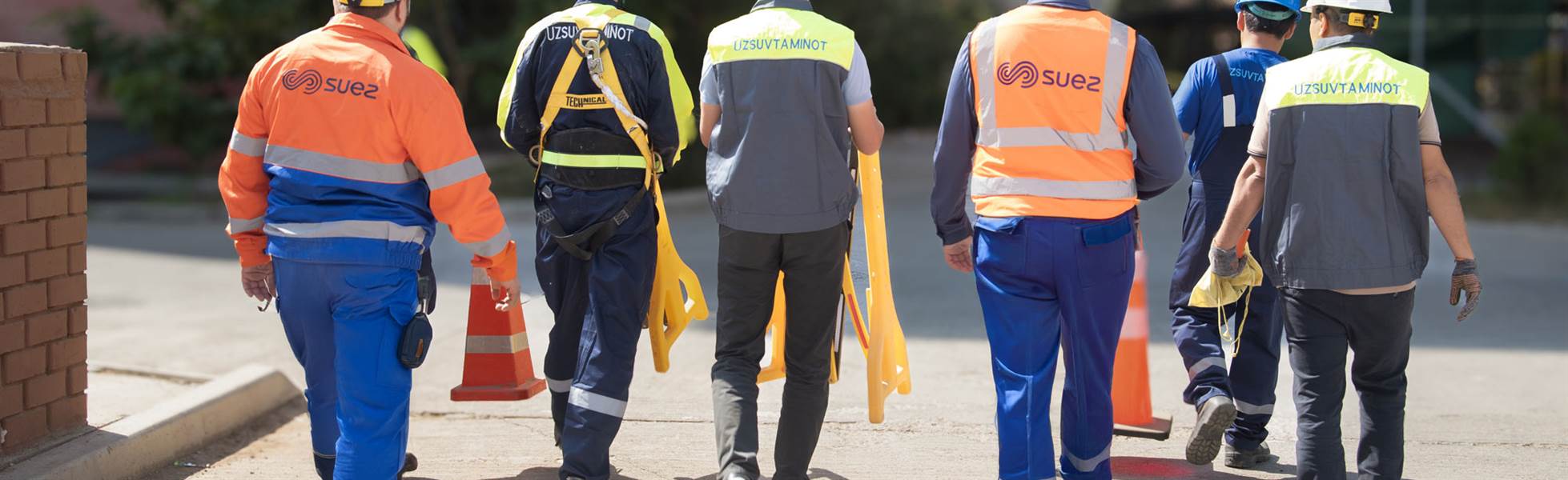
On November 22nd, 2022, SUEZ signed landmark agreements with its Uzbek partners, the National Water Company “Uzsuvtaminot”, the Municipality of Tashkent and the Ministry of Investment of Foreign Trade. The agreements mark the coming into force of  the capital city Tashkent water and sanitation project. Furthermore, they strengthen SUEZ’s position as the trusted strategic partner of Uzbek authorities for modernizing its water infrastructures and services.

Transformation through innovative technological solutions for the preservation of the water resources

SUEZ implements the latest innovation for smart water management, including physical technologies, digital solutions, management tools connected to a real-time control monitoring system. This approach improves the day-to-day management of water demand and supply, helping to meet the increasing drinking water demand.

The “Tashkent Water Transformation Plan”

The “Tashkent Water Transformation Plan”, launched in August 2023, is the perfect example to illustrate this. This project is implemented in collaboration with the Uzbek authorities. SUEZ is modernizing the Uzbek capital’s water and wastewater services and improving the management of its water company, Toshkent shahar suv ta’minoti in line with the highest international standards.


This contract includes:

  • A reduction in water losses by identifying 30,000 leaks using innovative methods. It will reduce water abstraction by 33 million m3 per year by the end of the project, equivalent to the annual consumption of an Uzbek town of 330,000 inhabitants.
  • The implementation of the latest digital solutions in a new Operations Center using smart decision-making tools enabling water and energy consumption reductions, to preserve resources and prioritize investments. Moreover, the installation of +600,000 smart meters will allow accurate billing.
  • The improvement of water quality, and the implementation of first-class customer services, comprising the creation of a Mobile App’.
  • The introduction of consumption-based billing will reduce the overall city's water consumption, helping it to meet the challenges of water scarcity in a context of global warming.

Training and know-how transfer

We are committed to fostering local expertise by providing technical and managerial assistance. We are training thousands of Uzbek water professionals, both on-site and abroad, raising the next generation of Uzbek leading managers and water specialists.

Since August 2023, we have launched an ambitious know-how and expertise transfer program which includes 1,500 days of training, 350 days of study abroad, and more than 1,200 days of technical assistance for the employees of the water company of Tashkent. Recognizing the importance of training highly qualified specialists from the early stages of education, we have signed an agreement with the “Tashkent Institute of Irrigation and Agricultural Mechanization Engineers” National Research University (TIIAME-NRU) to promote educational cooperation in March 2025. We are developing a module that will be integrated into an existing curriculum, aiming to better prepare students for their entry into the professional water sector.

Waste recycling and recovery

We support communities and businesses in shifting from a linear “take–make–dispose” model to a circular, resource-efficient economy. Across the entire waste cycle, the Group designs and operates integrated solutions to prevent waste generation, optimize collection and sorting, and maximize recycling and recovery of energy and secondary raw materials.

For industrial and commercial clients, we provide tailored waste management services covering mixed industrial and commercial waste, production offcuts, scrap metals, wood, construction and demolition waste, packaging, and biodegradable and food waste. These solutions combine customized collection, sorting, treatment and logistics to ensure regulatory compliance and reduce environmental impact.


We also have recognized expertise in hazardous waste management, handling sensitive streams such as hazardous residues, contaminated soils, chemical waste, sludge, healthcare and laboratory waste, batteries, solvents and oils. These wastes are treated through dedicated processes, including stabilization, secure storage, specialized treatment plants and, where appropriate, high-performance incineration or co-incineration.