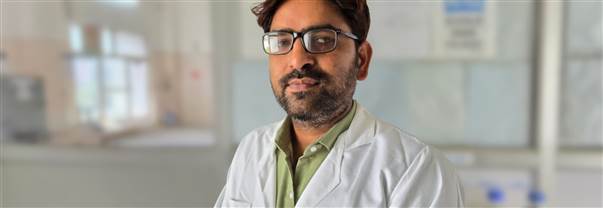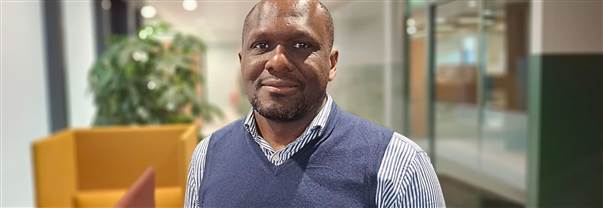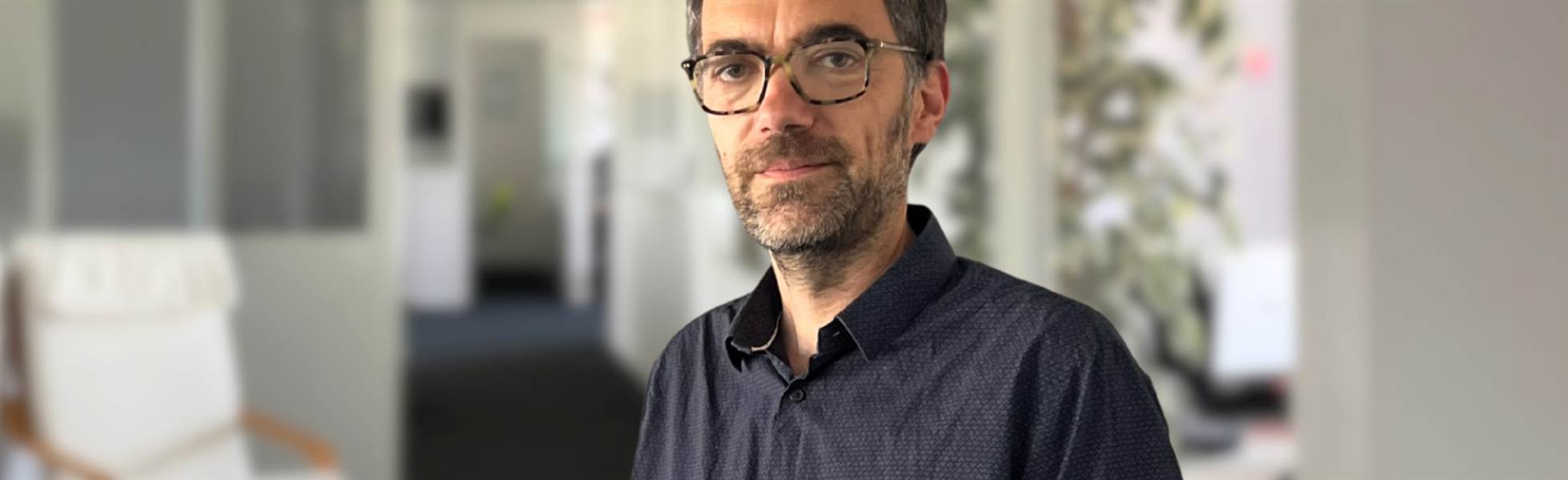

Jérôme, the upstream pharmacist
As a specialist in health risk assessment at CIRSEE, SUEZ’s international research centre, Jérôme has a job that few people would guess
Disciplines: Oceanography, Numerical modelling
Mission: To transform ocean data into practical solutions to protect coastlines and marine ecosystems

As Head of Oceanography at SUEZ, Marc uses numerical modelling to predict ocean movements and reduce the environmental impact on marine ecosystems. But when Marc talks about the ocean, he doesn’t immediately mention models or complex calculations; above all, he speaks of a living, ever-changing world that he has been observing all his life.
“I’ve always wanted to understand why things work the way they do,”
says Marc. This deep, almost instinctive curiosity has guided him ever since his student days. After completing a Master’s degree in mathematics, he discovered oceanography by chance during a presentation at the University of Brest. That day, everything changed: “I wanted to see how my knowledge could be put to use in the real world, and more specifically in the marine world.”
He then went on to complete a DEA (the equivalent of a master’s degree) followed by a PhD in physical oceanography, split between Ifremer – the French Research Institute for Exploitation of the Sea – and the university. It was a demanding scientific path, but one that opened up a vast field of exploration for him: that of the ocean, its dynamics and its interactions with human activities.
Upon completing his PhD, Marc joined Actimar, a subsidiary of SUEZ specialising in oceanographic modelling. There, he discovered a pioneering field of work, focused on innovation and the practical application of science. Now a business unit director, he oversees all studies and forecasting systems. His role centres on two main tasks.
Firstly, modelling the marine environment to anticipate the potential impacts of human activities on it and thus guide his clients towards the most suitable solutions.
His second task is more operational: providing his clients – mainly shipowners – with daily forecasts of waves, currents and winds, to optimise shipping routes and reduce their fuel consumption and, consequently, their greenhouse gas emissions.
Marc also works on major issues such as coastal erosion and coastal flooding. These are all challenges exacerbated by climate change and requiring cutting-edge scientific expertise.
For Marc, his passion for science is not solely about technological achievement. Above all, it stems from a need for understanding. “Science can explain practically everything around us. Thanks to it, we can understand things – the oceans, the world.”
This fascination has driven him all his life: understanding why the tides come in at fixed times, how currents form, or why certain coastal areas erode faster than others.
For him, science comes into its own when it becomes a tool for action. Complex equations and numerical models are not confined to laboratories: they are used to protect coastlines, support local authorities and help industries reduce their environmental impact. “We develop solutions to put science to work for a positive impact on the environment.”
He also encourages younger generations to pursue these careers, as the needs are immense, particularly along the coast. But he emphasises one point: staying connected to the field. “To truly do this job, you need to know the sea. To have your feet in the water, both literally and figuratively”.
Technological advances have already profoundly transformed Marc’s profession: “Today, we can be much more precise and carry out far more tests thanks to the computing power at our disposal.” And what about the future? Artificial intelligence will open up new possibilities, enabling us to analyse vast quantities of data, compare multiple models and speed up the interpretation of results. Nevertheless, he remains convinced that human expertise will remain irreplaceable. For at the heart of algorithms and models, there will always be the researcher’s perspective – their ability to interpret, question and make sense of the data. This alliance between human intelligence and technological power could well profoundly reshape our understanding of the oceans.

As a specialist in health risk assessment at CIRSEE, SUEZ’s international research centre, Jérôme has a job that few people would guess


.jpg?h=345&w=613&v=1&d=20260703T092039Z&format=jpg&crop=1&hash=90757CB716874BC1855DF959F0030705)