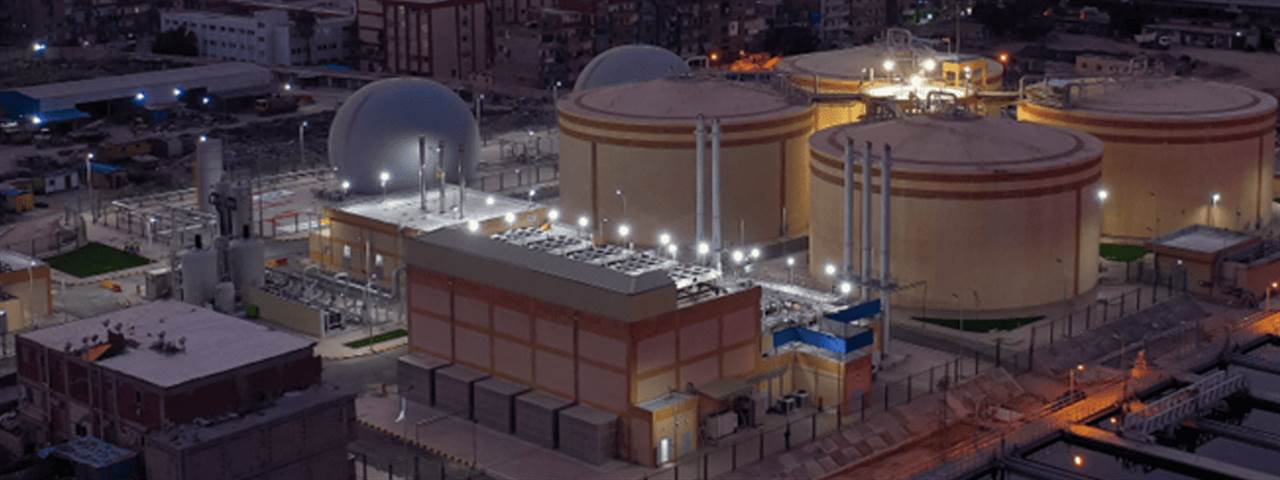


A project for urban wastewater treatment
At Alexandria East, the integration of sludge digestion marks a shift towards a more circular and resilient approach to wastewater management. The project has helped reduce greenhouse gas emissions, improve energy autonomy and lower the volume of sludge requiring treatment. The project was delivered within a short timeframe in a dense urban environment and shows how wastewater infrastructure can help address local environmental challenges.

Egypt

Wastewater

800,000 m³/day

Commissioning 2022
Support the local energy transition through large-capacity anaerobic digestion

Climate pillar

Alexandria is facing rising energy costs and stricter regulations on greenhouse gas emissions, reflecting a challenge shared by many wastewater treatment plants: reducing energy dependence while limiting environmental impacts. This challenge is even greater in a dense urban environment. In this context, sludge management has become an important lever for improving energy performance. Many operators and public authorities are looking for ways to turn these constraints into opportunities for energy recovery and lower-carbon operations.
The Alexandria approach is based on using wastewater infrastructure as a source of renewable energy while improving environmental performance. The sludge digestion unit is a key part of this strategy. By recovering biogas from sludge treatment, the plant produces nearly 50 GWh of energy per year, covering between 60% and 65% of its electricity needs. This performance helps reduce greenhouse gas emissions by around two thirds.
By integrating SUEZ technologies into its operations, the site also supports a more circular approach while reducing exposure to energy market fluctuations and limiting its carbon footprint. Digital tools such as O2C® Net-Zero, developed by SUEZ to model carbon emissions across the project lifecycle, also support this work.
Optimise sludge management to improve environmental performance

Nature pillar

For many wastewater treatment plant operators, sludge management is a complex issue from both a logistical and environmental perspective. Residual sludge production requires transport, storage and final treatment solutions, which involve significant use of resources such as energy, chemicals and water. These constraints increase operating costs and add to the environmental footprint of the facilities. Many operators are therefore looking for ways to optimise sludge management while reducing impacts on soils, natural environments and resources.
To address these challenges, SUEZ develops solutions that reduce the volume of sludge requiring treatment while improving sludge recovery and management. Through anaerobic digestion processes, sludge can be stabilised and dewatered more efficiently while limiting energy and chemical consumption.
At Alexandria East, sludge digestion reduces the volume of sludge requiring treatment by 35%, which also reduces transport needs, energy use and chemical consumption. The stabilised sludge produced by the process can be reused as agricultural fertiliser or in industries such as cement production. The biogas generated is converted into electricity through cogeneration, allowing the plant to cover between 60% and 65% of its energy needs.
Support local communities and develop local expertise

Social pillar

Delivering technical infrastructure projects in dense urban areas is a challenge for many local authorities and operators. These projects must meet several constraints, including safety requirements, limiting impacts on nearby residents, integrating the infrastructure into the urban environment and working within tight deadlines. They require a balance between technical performance, local acceptance and operational coordination.
In this context, successful delivery depends on effective risk management, appropriate organisation and close coordination with stakeholders. It also relies on compliance with regulatory requirements related to safety, noise and gas management, as well as careful urban and landscape integration from the design phase onwards and the involvement of local expertise.
Particular attention was given to local acceptance of the project. No odour complaints were reported by nearby residents, and visits are regularly organised for schools and universities to support transparency and local engagement. Sludge management is handled by a local contractor responsible for transporting dried sludge to a storage facility.
The Alexandria East project shows that complex infrastructure projects can be delivered in dense urban environments while ensuring long-term integration and operation.