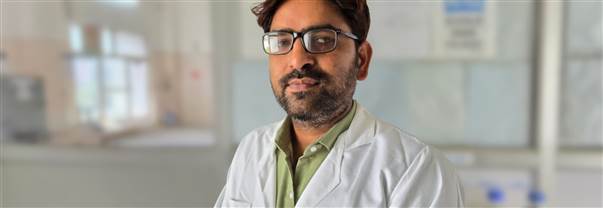

A specialist in public health risk assessment at CIRSEE, SUEZ’s international research centre, Jérôme has a job that few people would guess. Yet he deals with something essential, at the very heart of our daily lives: water quality. Meet a pharmacist who has forged his own path, far from traditional pharmacies.
It all began with an unexpected career path. Jérôme is a pharmacist, having spent six years studying at the Faculty of Pharmacy in Châtenay-Malabry, now part of Paris-Saclay University. But no, his day-to-day work does not involve handling prescriptions. When he joined CIRSEE in 2015, he tells us that some of his colleagues asked him, intrigued: “But that’s odd, you’re a pharmacist, what are you doing here?”
Pharmacy studies are in fact a blend of chemistry, biology, toxicology and physical chemistry. As one professor put it: “A pharmacist is somewhat like the polytechnic engineer of the healthcare.”
Jérôme has made this idea his own. He now applies this broad scientific background to water. And he is convinced: “In my day-to-day work, I use my skills as a pharmacist far more than some of my colleagues in the pharmaceutical industry.” What steered him down this path? A teacher whose public health and hydrology courses proved decisive. A pivotal encounter that led Jérôme to undertake internships at CIRSEE and then at ANSES (the French National Health Security Agency), after which he spent two years working in the same professor’s laboratory. The CIRSEE then took him in, and he stayed on there.
My role is to make science useful for those who work every day to ensure water qualityJérôme
An investigator at the heart of water
"I see myself a bit like an investigator,
” says Jérôme with a touch of humour. At CIRSEE, he joined a team specialising in understanding water quality.
His daily work revolves around two main tasks that complement and reinforce one another. On the one hand, research, to improve the methods for assessing health risks. On the other, technical support, to translate this knowledge into concrete actions on the ground. “My role is to make science useful for those who work every day to ensure water quality,” he explains.
In practical terms, his work helps identify traces of pollution and microbes in water, and assists in determining whether existing treatment processes are properly designed, or whether dosage and technology need to be adjusted. “It’s not just about measuring, but about understanding and anticipating,
” he explains, highlighting the strategic dimension of his expertise.
The objective remains constant: to guarantee the quality of tap water, whatever the conditions. Finding the right level of treatment for each local context is a delicate balance between safety and sustainability. Every decision is based on solid scientific data, which Jérôme helps to gather. “We’re always looking for the best compromise—one that protects public health while optimising treatment
,” he explains.”
When science is shared, it expands
Beyond research and technical support, one aspect matters greatly to him: scientific outreach. For his work also involves disseminating knowledge widely: writing publications in partnership with academics, presenting findings at national and international conferences, and helping to gain recognition for the methods developed within SUEZ.
“Sharing our progress, comparing it with that of others, and making it visible: this is essential. The more widely our methods are known, the more they benefit the sector as a whole
.”
An analytical revolution underway
TWhen asked how he sees his discipline evolving in the coming years, Jérôme thinks first and foremost of the rapid advances in analytical techniques. He notes a genuine analytical revolution over the last twenty years, which is still ongoing: molecular biology methods for environmental microbiology, or non-targeted chemical analysis, which provides the most comprehensive possible overview of a sample’s micropollutants in a single run. Advances which, in his view, “completely reshuffle the deck
” when it comes to risk assessment. On artificial intelligence, he remains measured: promising, yes, but on the condition that it is based on well-constructed data. “AI is a bit like the icing on the cake, once everything has been done properly beforehand.
”
Science in the service of water, and the planet
After ten years at CIRSEE, what still drives Jérôme every day is something simple: purpose. “Pharmacy studies are a field that doesn’t close doors; on the contrary, they open many, not just for working as a community pharmacist
.”
For those hesitating to pursue a career in environmental science, his argument is straightforward: “In our environmental professions, we don’t ask ourselves why we get up in the morning. We know we’re contributing to something that matters: water quality, public health, and the preservation of resources.
”
In a world where the search for meaning increasingly guides career choices, Jérôme embodies one possible path: that of a scientist who has chosen to put his expertise at the service of what is essential.