Water quality
We treat and distribute fresh water in accordance with current regulations to guarantee drinking water of high quality that is safe to drink and complies with health requirements for everyone.

As experts in water infrastructure and services, we support you throughout the entire drinking water production cycle. First of all, we advise you and implement the appropriate solutions for the mobilisation of resources: groundwater drilling, surface freshwater intake, catchment of karst springs, possible alternative resources such as seawater or non-conventional waters, in line with local regulations.
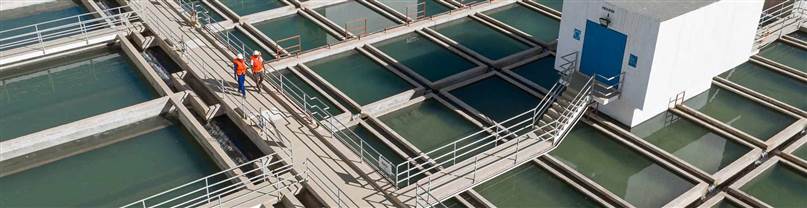
Around the world, we support you from the design and construction of drinking water production plants to their operation and maintenance. The different treatment steps are designed according to the quality of the raw water available and the quality of drinking water required. We provide you with state-of-the-art solutions to produce very high quality water, for example by eliminating micropollutants (PFAS and pesticide metabolites, etc.) or by reducing its limescale content.
We provide services for the management of produced water and infrastructure. Thus, we assure you of the high quality of the water produced via regular, regulatory or specific analyses.
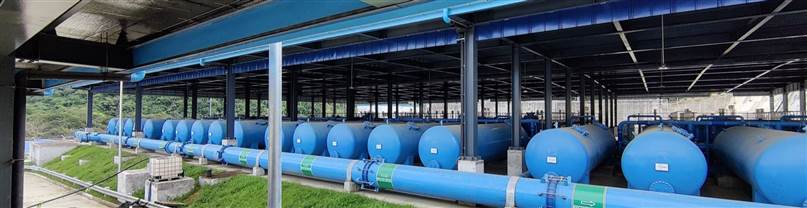
We adapt these drinking water production plants to urban, peri-urban or rural contexts and constraints. Factories can be the subject of a specific architectural integration. To adapt to certain geographical constraints or to quickly provide water to rapidly developing populations, factories can be delivered prefabricated: modular and containerised decentralised compact units (DCUs) are a recognised and widespread solution in some countries.
Throughout the world, the natural resources used to produce drinking water can come from different sources:
- Underground freshwater aquifers, more or less deep, which are renewed with each rainfall.
- Karst veins, "underground rivers" carved by water in limestone soils, whose resurgences form natural sources of fresh water.
- The fresh surface water that flows into rivers and streams...
When these resources are not sufficient, alternative resources are mobilised, such as fossil groundwater (which is not renewed), seawater, or non-conventional water (rainwater, treated wastewater, etc.), in line with local regulations.
The treatment processes implemented to produce drinking water depend on the quality of the raw water (depending on the resource used) and the quality of the water that is to be obtained (for compliance with drinking water standards).
Firstly, the pre-treatment stages (screening, sieving, etc.) make it possible to retain pollutants and coarse particles.
Then, decanting/clarification, then filtration (on sand or ultrafiltration membranes in particular) retain the fine particles and organic matter.
Adsorption on activated carbon retains micropollutants such as pesticides.
Low-pressure reverse osmosis makes it possible to retain dissolved salts such as limestone, or certain pollutants, and to retain micropollutants.
In the case of seawater desalination, high-pressure reverse osmosis is used.
Remineralisation makes it possible to give sufficient minerality to naturally very soft water or to water from a desalination process.
Finally, the disinfection stages, mainly by ultraviolet, chlorination, or ozonation, guarantee the absence of microbiological pollution in the distribution networks.
No drinking water treatment plant combines all these steps: the treatment systems are adapted to raw water, from simple chlorination for excellent quality groundwater to complex processes for surface water of degraded quality.